
To Build Is to Remember: The Architecture of Fasil Giorghis in Ethiopia at Tadias Magazine www.tadias.com/07/01/2025/to-build-is-to-remember-the-architecture-of-fasil-giorghis-in-ethiopia/
: Stones of Memory and Paths of Renewal
Giorghis sees in the Adwa Heritage Preservation Project a rare and vital convergence: “a good example of public private partnership which involved the local community as well.” It is, in many ways, a model for how heritage work in Ethiopia—and indeed across Africa—might be reimagined. Rather than imposing preservation from above or outsourcing it to foreign benefactors, this initiative breathes from the ground up, rooted in the memory of place and animated by the stewardship of those who live among its fading stones.
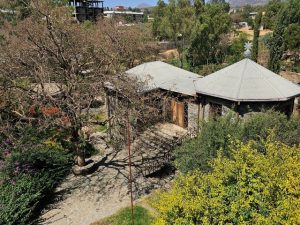
[Adwa-heritage-center-TADIAS-4.jpg] Adwa Heritage Center. (Photo: courtesy of the author)
Initiated by Elizabeth Ambaye, a native daughter of Adwa, and her husband Rick Stoner, a former Peace Corps volunteer from Columbus, Indiana, the project is at once intimate and ambitious. What began as an effort to rebuild a single ancestral home has since evolved into a multi-pronged effort to rescue Adwa’s architectural past from erasure. The Adwa Heritage Center now stands completed—its walls enclosing not only a physical compound but a vision of cultural continuity. Adjacent to it, the Assem Park project restores the natural and urban landscape, offering safe pedestrian access and green reprieve in a city rapidly giving way to concrete ambitions. Most urgent of all is the Campaign to Save Old Adwa, a quiet rebellion against the logic of modernization that sees no value in what is old.
Here, Giorghis’s imprint is subtle but foundational. As professor and mentor, he has guided two graduate students in the painstaking task of mapping, photographing, and documenting the Medhane Alem neighborhood—one of Adwa’s oldest quarters and now officially designated as the city’s Old Town. This is not mere academic exercise. Their work, slated for exhibition at the Heritage Center, is a form of architectural witnessing: a visual and spatial record of what still stands, and what could yet be saved.
For Giorghis, this project embodies the principles he has long championed—architecture not as vanity, but as the quiet labor of memory. It is heritage preservation practiced with humility, in dialogue with place and people. That it emerged from a marriage of personal memory, public commitment, and pedagogical vision only confirms what he has long believed: that beauty, like justice, requires collaboration—and that the built environment, when treated with care, can become a vessel for both.
N.
Recent Comments